The asset is not the system
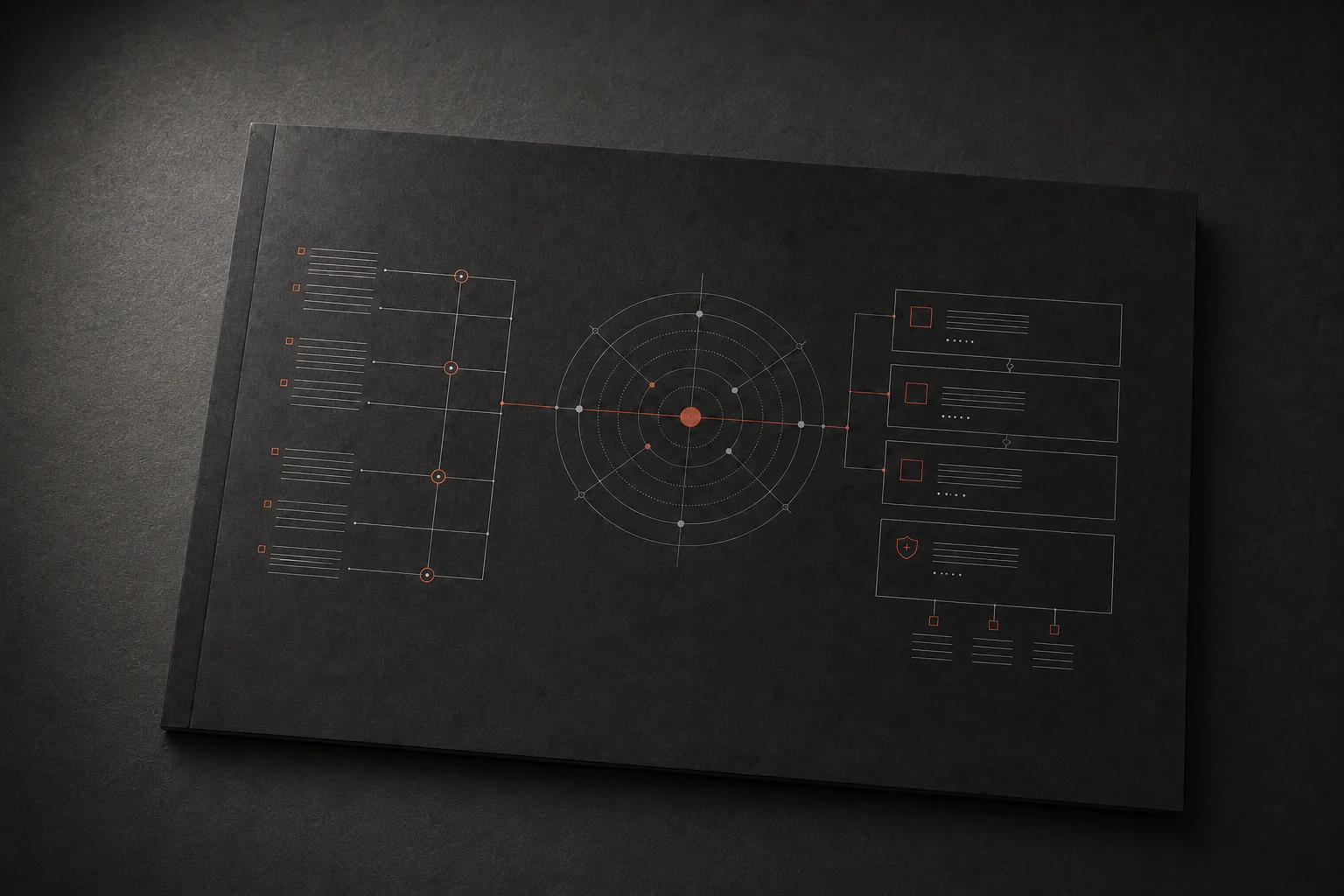
A logo, website or brochure can be beautifully resolved and still leave an organisation without a reliable way to make its next decision. Assets are outcomes: visible answers produced at a particular moment. The system is the less visible structure behind them—the principles, relationships, responsibilities and controls that allow each answer to belong to the same organisation. When this structure is absent, every new requirement becomes a fresh design exercise. The work may look polished in isolation, but the organisation remains dependent on memory, taste and the availability of whoever made the last piece.
Begin with decisions, not formats
Starting with a format encourages the project to solve only what is immediately visible. Starting with decisions asks a more useful set of questions. What must remain recognisable? Which information has priority? Who will produce the next version? What must work across print, digital, motion or physical space? These questions expose the governing requirements before typography and composition absorb the attention. They also reveal where a single visual treatment would be too narrow. A system begins to form when the answers can guide several outputs without forcing those outputs to look identical.
Structure reduces repeated invention
When hierarchy, language, image behaviour, material choices and production rules are established early, every new piece of work begins with useful constraints. Constraints are valuable when they remove unproductive ambiguity while leaving room for judgement. A team should not have to rediscover how a heading behaves, which colour carries emphasis or how source files are organised each time a deliverable is requested. The saved effort can be directed towards the particular audience, message and condition of use. Coherence then becomes a result of shared logic rather than repeated imitation.
Test the system at its edges
The hero application is usually the easiest place for a system to succeed. More revealing tests are a long heading, a small mobile screen, an urgent update, an unfamiliar contributor or a low-cost production method. These conditions show whether the rules are clear enough, flexible enough and proportionate to real use. Edge testing also separates a design language from a single art-directed composition. If the system collapses whenever the content, format or operator changes, the problem is structural. Finding that weakness early is not a failure; it is how the governing logic becomes credible.
Coherence is operational
A system becomes valuable when people can use it without the original designer present. It should explain what remains fixed, what may change and how a new application should be judged. Templates and guidelines help, but ownership, approval routes, naming conventions and source organisation matter too. They determine whether the intended structure survives daily pressure. This is the point at which identity moves beyond presentation and enters practice: not because every output is identical, but because different outputs can be traced back to the same decisions and produced with a dependable level of control.
Build the governing logic first. Let every asset prove that the logic can work.